














KRYPTOKAP · SERIES 2026
Total crypto market cap

Every cryptocurrency, ranked by what it's worth

Market gauges

Calculated from current prices.

KryptoKap Pulse

Market mood

History and details →
How it's scored
Season meter

Altcoin season

Share of the top 100 coins beating Bitcoin over 90 days.

Bitcoin seasonAltcoin season
History and details →
How it's scored

Stablecoins and gold tokens are left out. 75 or more means altcoin season; 25 or less means Bitcoin season.

Index

KryptoKap 10

The ten largest coins, weighted by market cap.

History and members →
How it's built

Started at 1,000. Stablecoins and gold tokens excluded. Members are the ten largest coins at each update, and the divisor adjusts when they change so the line stays continuous.

Countdown

Bitcoin halving

Every 210,000 blocks, the reward for mining new Bitcoin is cut in half.

1,050,000
Estimated date
Reward per block3.125 → 1.5625 BTC
Fees, blocks and network →
How it's estimated

Bitcoin aims for one block every 10 minutes, so the date is the remaining blocks × 10 minutes. Real block times vary, so the estimate drifts by days.

DeFi

Total value locked: money deposited in lending, trading and staking apps, and where it lives.

Total value locked

By chain

Stablecoins

Digital dollars: how many exist, who issues them, and whether each one is holding its $1 peg.

Total supply

Issuers and pegs

CoinSupplySharePrice
A price more than 0.5% from $1.00 is flagged in red.

Market map

Coins grouped by sector. Circle size is market cap, color is the move since the start of the week. Press play to replay the week.

Swipe sideways to explore the map →
DownFlatUp

The week's race

The ten biggest coins over the last 7 days.

Milestones

Flippenings and market cap thresholds, logged as they happen.

Headlines

The latest crypto news from major outlets, linked to the coins they mention.

All coins

Tap or click a row for quick stats, or open the full profile.

Screener →
#CoinPrice1h24h7dMarket capVolume 24hSupplyLast 7 days

Tools

Calculators for prices, market caps, history and risk, using live data.

Today's crypto prices by market cap

Crypto ETF · Spot Solana

BSOL: Bitwise Solana Staking ETF

Holds Solana directly, so one share tracks the price of the Solana the fund owns, minus a yearly fee.

KryptoKap · Fund profileUS-listed ETF
SOL
BSOL
Bitwise Solana Staking ETF
IssuerBitwise
ExposureSpot Solana
Yearly fee0.20%
NAV$11.27
Fund assets$802.9M
Solana held10,013,546 SOL
Latest daily flow+$0
Day change0.0%

Figures as of Nov 13, 2026, from Bitwise's own published fund data. Flows are worked out from the daily change in shares outstanding times NAV.

NAV over time

Nov 4, 2026 to Nov 13, 2026 · low $11.27 · high $13.10

Daily flows

Nov 5: +$0Nov 6: −$14.4MNov 9: −$5.9MNov 10: −$8.2MNov 11: +$0Nov 12: +$1.7MNov 13: +$0
Net over the period: −$26.8M. Green days added shares (money in), red days removed them.
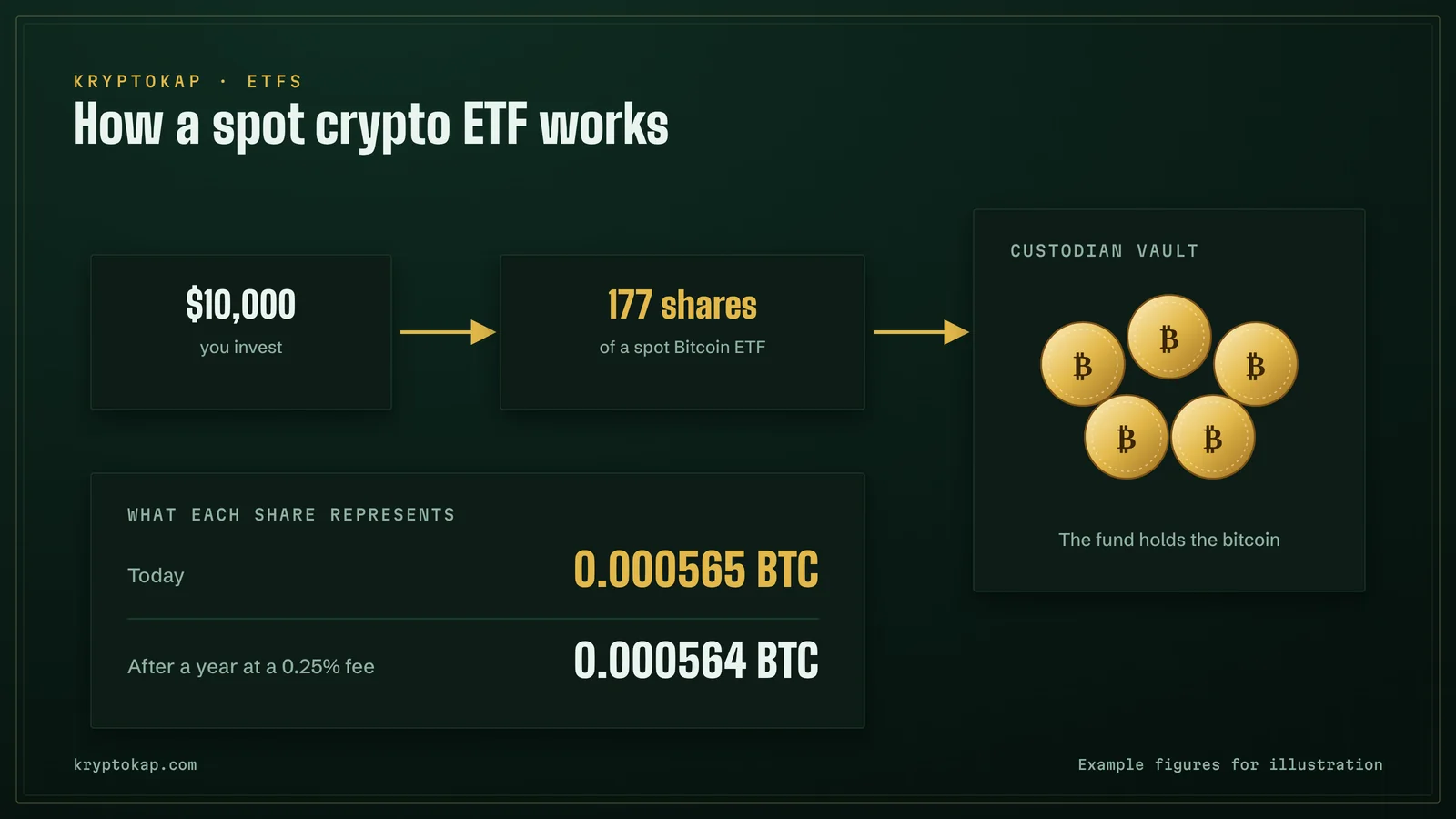
$10,000 buys 177 shares of a spot Bitcoin ETF, which holds the bitcoin with a custodian. Each share represents about 0.000565 BTC, falling to about 0.000564 BTC after a year of 0.25% fees.
Your money buys shares; the fund buys and holds the coin with a custodian. The yearly fee is paid in coin, so the amount behind each share shrinks slightly over time. Free to reuse

What you own

Legally, most spot crypto funds like this are exchange-traded products (ETPs) set up as trusts, not funds registered under the Investment Company Act of 1940 like most stock ETFs, so some investor protections differ. Everyday usage calls them all ETFs. You own a share of a trust that holds Solana with a custodian. You get the price exposure without managing keys or a wallet, and you can hold it in an ordinary brokerage account. You can't withdraw the coins themselves, and the yearly fee comes out of the fund's holdings a little each day.

Each share currently represents about 0.13855743 SOL. That number shrinks slowly as the fee is paid. Compare with Solana's own price.

Where the numbers come from

KryptoKap reads Bitwise's own published fund data once a day after the US market close. NAV is the value of the fund's holdings per share, not the trading price, though for these funds the two are usually close. Visit the issuer's site.

The cheapest similar fund is GSOL at 0.19%. On $10,000, BSOL costs about $1 more a year. Fees aren't everything: trading volume, spreads and the issuer matter too. Run the fee race

Questions about BSOL

Does BSOL hold real Solana?

Yes. BSOL is a spot fund: it holds Solana with a custodian and stakes it. Each share represents an amount of Solana that changes slowly over time, as staking rewards add to it and the fee takes a little away.

Does BSOL pay out staking rewards?

Not as cash. BSOL stakes its Solana and adds the rewards to the fund, so its NAV per share can grow a little faster than Solana's price alone. Rewards depend on the network's staking yield, and part of them can go to the issuer or the staking provider, so check the prospectus for how much reaches the fund. Ask a tax adviser how rewards earned inside the fund affect you.

How is BSOL different from buying Solana directly?

You get Solana's price in an ordinary brokerage account, with no wallet or keys to manage. In return you pay a yearly fee, can only trade during market hours, and can't withdraw or send the coins.

How much does BSOL cost to own?

Its yearly fee is 0.20%, about $20 a year on $10,000, taken out of the fund's assets a little each day. Brokerage commissions and the bid-ask spread come on top.

When can I trade BSOL?

During US stock market hours, 9:30 a.m. to 4 p.m. Eastern on weekdays, plus extended hours at some brokers. Solana itself trades around the clock, so a big move over a weekend or a holiday shows up as a jump in BSOL's price when the market next opens.

Who runs BSOL?

Bitwise. The issuer's prospectus has the full objective, holdings and risks.

Similar funds

GSOL · QSOL · FSOL · VSOL · TSOL · All crypto ETFs

Not investment advice. Fees and figures can change; check the issuer's documents before investing.